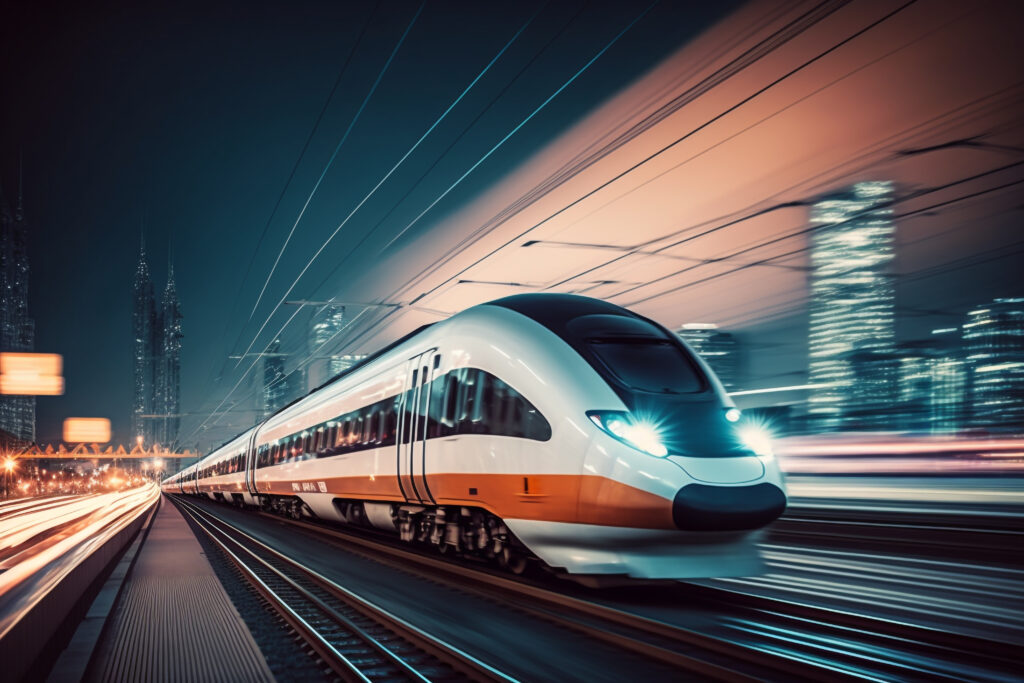
While aviation conquered the skies, a new revolution is happening on the ground — the rise of high-speed rail.
From Tokyo to Paris, and now emerging across India and the U.S., bullet trains are redefining how we move — faster, greener, and smarter.
In an age of climate urgency, high-speed trains are not just an engineering marvel; they are the future of sustainable global mobility.
The Rise of the Bullet Train
The world’s first bullet train — Japan’s Shinkansen, launched in 1964 — changed transportation forever.
Since then, countries like China, France, Germany, Spain, and South Korea have built vast high-speed networks, with speeds exceeding 400 km/h.
Now, with megaprojects like India’s Mumbai–Ahmedabad corridor and California’s High-Speed Rail, the revolution is going global.
Why High-Speed Rail Matters
- Speed and Efficiency:
Trains connect major cities faster than air travel when factoring airport logistics. - Sustainability:
High-speed trains emit up to 90% less CO₂ per passenger compared to flights. - Economic Impact:
Infrastructure projects create jobs, boost tourism, and link regional economies. - Comfort and Productivity:
Professionals can work onboard — blending business with mobility seamlessly.
Technological Breakthroughs Powering Modern Rail
- Maglev Trains: Using magnetic levitation, trains like Japan’s L0 Series reach speeds over 600 km/h with near-zero friction.
- Hyperloop Concept: Elon Musk’s vision of vacuum-sealed pods may one day move passengers at airplane speed.
- AI Traffic Control: Intelligent systems optimize routes and prevent collisions in real time.
- Green Power Integration: New rail systems are powered by renewable energy grids and solar installations.
The train of the future is not just fast — it’s smart, silent, and sustainable.
Global Leaders in High-Speed Innovation
- Japan: The pioneer of reliability and precision.
- China: The world’s largest network, connecting over 500 cities.
- France: The TGV remains Europe’s speed and design benchmark.
- Spain: Leading in renewable-powered rail networks.
- India: Emerging as Asia’s next high-speed hub with international collaboration.
The Environmental Edge
Trains are central to the green transition.
Unlike aviation, which struggles with electrification, rail offers a viable, scalable path to net-zero travel.
A high-speed train can carry 1,000 passengers with the same energy consumption as 30 cars — making it the cleanest mass transport mode on land.
The Future: Smart, Integrated Mobility
The next generation of mobility will combine AI, IoT, and multimodal ecosystems, integrating rail with last-mile electric transport and digital ticketing.
Travelers will move through “connected corridors” — from doorstep to destination — seamlessly.
This is the new urban fabric: where time is saved, carbon is cut, and connection becomes effortless.
Conclusion
The high-speed revolution is more than a triumph of technology — it’s a statement of purpose.
It symbolizes humanity’s commitment to progress that doesn’t compromise the planet.
In the coming decades, as bullet trains link cities, countries, and continents, they’ll also connect something deeper — our shared vision for sustainable, intelligent mobility.