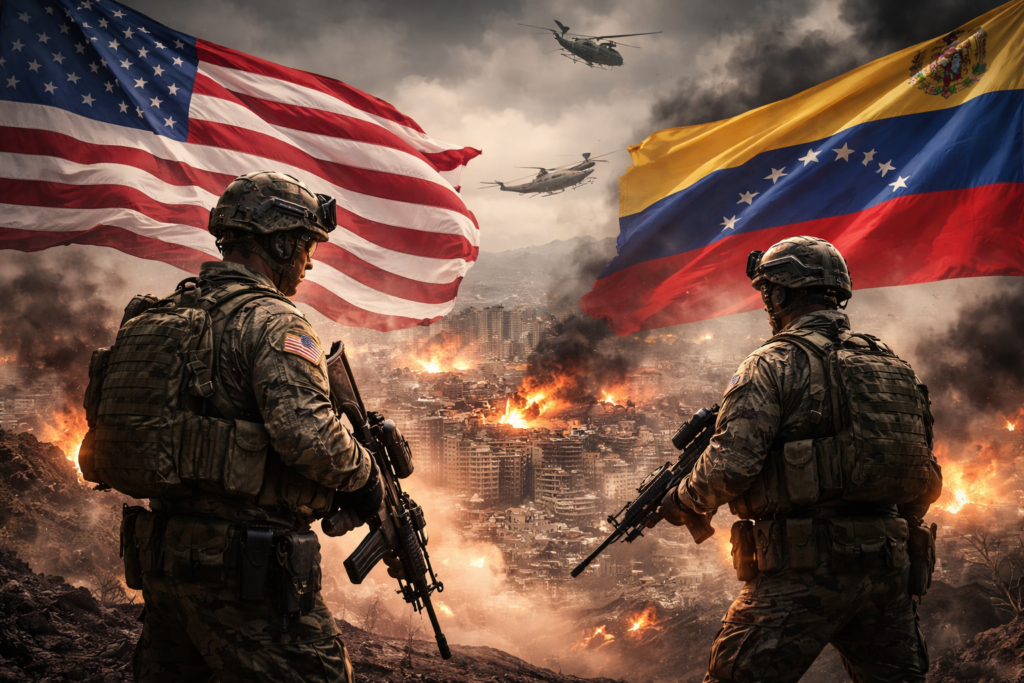
In early January 2026, relations between the United States and Venezuela reached an unprecedented and highly controversial turning point when U.S. forces executed a military operation in Caracas, resulting in the capture of Venezuelan President Nicolás Maduro and his wife Cilia Flores. This operation, which followed months of military escalation and strategic pressure, has sparked intense debate globally over legality, sovereignty, and regional stability—drawing reactions from governments, civil society, and international institutions.
Historical Strains and Escalation
U.S.–Venezuela relations have been fraught for decades. The United States has long criticized the Venezuelan government for authoritarian practices, economic mismanagement, and human rights abuses, while Venezuela has accused the U.S. of interference in its internal affairs. Sanctions targeting Venezuelan officials and the state oil sector have been a persistent feature of bilateral relations.
Tensions intensified in 2025 when the U.S. administration expanded its use of military force under a broad authorization initially framed as action against drug trafficking and organized crime, particularly vessels allegedly transporting contraband across the Caribbean and Eastern Pacific. This campaign, often referenced as Operation Southern Spear, involved a series of U.S. airstrikes and naval operations beginning in mid-2025.
According to analyses of the military buildup, the U.S. deployed warships and aircraft into the Caribbean beginning in August 2025, creating the largest U.S. naval presence in the region since the Cuban Missile Crisis. The U.S. military carried out dozens of strikes against vessels it said were associated with drug trafficking—and Venezuela viewed these actions as an increasingly direct threat to its sovereignty.
January 3, 2026: The Raid and Capture of Maduro
On January 3, 2026, U.S. forces conducted a complex military operation in Caracas aimed at dismantling Venezuelan leadership and capturing President Maduro. According to reporting by The Guardian and PBS, explosions were reported in and around Caracas early on the day of the attack, targeting key military installations and safe houses. U.S. special forces eventually located and seized Maduro and his wife, transporting them to the United States where they were detained and charged with narco-terrorism and related criminal offenses.
President Donald Trump publicly stated that the U.S. intended to “run Venezuela” temporarily until a “safe, proper and judicious transition” could be established, including bringing U.S. oil companies into the revitalization of the country’s energy infrastructure. Critics raised immediate concerns that such rhetoric underscored economic motivations tied to Venezuela’s vast oil reserves—the largest in the world—rather than purely security or humanitarian objectives.
Motivations: Security, Narcotics, and Oil
The Trump administration framed its 2025 build-up and early 2026 actions in part as counter-narcotics and law enforcement operations, claiming that Venezuelan authorities and allied criminal networks were deeply involved in illegal drug trafficking into the United States. The designation of Venezuelan criminal groups like Tren de Aragua as foreign terrorist organizations and accusations of narcoterrorism have been central to this narrative.
However, many analysts believe the U.S. intervention was driven by a combination of factors, including longstanding geopolitical rivalries, strategic competition over oil resources, and a desire to reassert American influence in a region where it has faced growing Chinese and Russian engagement. Venezuela’s oil industry, crippled by years of sanctions and mismanagement, remains a key piece in global energy geopolitics, especially at a time when energy markets remain strained.
Military Operations: Tankers and Naval Seizures
In addition to the high-profile capture of Maduro, the U.S. military has engaged in sustained maritime operations against Venezuelan-linked oil tankers. As of January 20, U.S. forces have seized multiple vessels over alleged sanctions violations, including the Liberian-flagged MV Sagitta and other ships accused of transporting Venezuelan oil in contravention of U.S. declared embargoes. These seizures are part of the broader effort to control Venezuelan oil exports and assert U.S. influence over energy flows from the region.
In several instances, tankers previously out of tracking range have resurfaced near Puerto Rico and other ports, fueling speculation about their final destinations and the legal complexities surrounding maritime seizures. Observers note that these operations have broader implications for international maritime law and global oil markets.
Human Impact and Casualties
The U.S. military action has not been without human cost. Reports indicate that at least two civilians were killed in the January 3 operation, including a Colombian woman identified as Yohana Rodríguez—highlighting the civilian toll of urban strikes. Furthermore, Venezuela’s Defence Ministry has claimed that dozens of its soldiers were killed during the raid to capture Maduro, underscoring the intensity of the conflict and its lethal consequences for military personnel.
These casualties have fueled outrage within Venezuela and among human rights observers, many of whom argue that the military operation violated core principles of international law, including respect for sovereignty and prohibitions on the use of force without United Nations authorization.
Regional and Global Reactions
The global response to the U.S. operation has been starkly divided. Several Latin American governments—including Brazil, Chile, and Mexico—criticized the strikes and called for restraint and peaceful dialogue. Others have urged respect for Venezuelan sovereignty and condemned the use of unilateral military force.
International organizations and civil society groups have raised alarm over the broader implications for multilateralism and international law, suggesting that the U.S. action sets a dangerous precedent for interventions without clear legal backing.
Even within the United States, the operation has sparked debate about legality and ethics. Constitutional scholars have questioned whether the actions fall under the War Powers Resolution, which limits the President’s ability to commit U.S. forces without Congressional approval. Religious leaders and lawmakers have also weighed in, framing the intervention within broader discussions about moral obligations and American foreign policy.
Geopolitical Implications
The U.S. campaign in Venezuela has ramifications beyond Western Hemisphere politics. Analysts warn that the confrontation may embolden rival powers. For example, some commentary suggests that the U.S. focus on Venezuela could shift strategic attention, influencing China’s calculations regarding Taiwan and broader Indo-Pacific dynamics—a complex interplay that extends the impact of the Venezuelan crisis into global geopolitical contests.
The operation may also alter diplomatic alignments within Latin America, potentially strengthening regional calls for autonomy from U.S. influence and bolstering ties with other global powers.
Looking Ahead: Legal, Political, and Economic Questions
As Venezuela enters an uncertain transition—with Vice President Delcy Rodríguez reportedly positioning herself as an interim authority and negotiations reportedly occurring behind the scenes—the future of Venezuelan governance remains ambiguous.
Key questions persist:
-
What legal frameworks govern U.S. actions and the detention of Maduro abroad?
-
How will Venezuela’s oil industry be managed if U.S. control expands?
-
What are the long-term implications for regional security and U.S.–Latin America relations?
-
Can diplomatic solutions, rather than military approaches, rebuild stability?
Conclusion
The U.S. attacks on Venezuela and the capture of President Nicolás Maduro in early January 2026 represent one of the most dramatic shifts in Western Hemisphere geopolitics in decades. What began as an ostensibly targeted intervention against alleged drug trafficking and corruption has evolved into a full-blown confrontation with far-reaching consequences for international law, energy politics, and regional diplomacy.
As the world watches, the Venezuelan situation underscores the complexities and risks inherent in military intervention, raising critical questions about sovereignty, legality, and the future of U.S. foreign policy in the Americas and beyond.